
Pain to Profit: Which Recovery Boots for Ironman Preparation?
Magdalena Bürk
Ironman training is intense. Three disciplines, long sessions, and high training volumes challenge the body week after week. The legs, in particular, are constantly under strain.
Many triathletes invest a lot of time in training and equipment but often underestimate a crucial factor: recovery. Those who recover faster can achieve higher training quality and maintain consistent training in the long run.

Training Load in Ironman: Swimming, Cycling, Running
Why Recovery is Crucial for Ironman Athletes
The Ironman distance combines three very different challenges:
- 3.8 km swimming
- 180 km cycling
- 42.2 km running
Even in training, this means several long sessions per week. Many triathletes also do brick workouts, where cycling and running are combined directly.
Typical problems in intense training phases
In intense training blocks, similar challenges often arise:
- heavy legs
- muscle fatigue
- reduced performance
Especially with high volumes, fatigue can build up over several days.
Why good Recovery determines performance
Successful Ironman preparation means not just more training, but also better recovery. Recovery determines how well your body handles stress and how quickly you're ready for the next session.
Recovery Boots in triathlon: What's behind the compression massage?
How Recovery Boots Work
Recovery Boots use pneumatic compression. The boots contain multiple air chambers that inflate and deflate in sequence.
This principle creates a rhythmic pressure massage along the legs.
Typical elements:
- multiple air chambers
- sequential compression from bottom to top
- consistent pressure pulses
Many athletes find this application pleasant and relaxing—especially after long training sessions.
Why Triathletes Benefit Especially
Triathlon puts a lot of strain on the leg muscles through cycling and running. Recovery Boots can therefore be particularly interesting for:
- Athletes with high training volume
- intensive training phases
- training camps or competition preparation
Many triathletes use compression massage to consciously support their recovery between sessions.
When Recovery Boots are especially worthwhile in Ironman preparation

After long cycling sessions
Long bike rides are among the most important training sessions in Ironman training. After several hours in the saddle, the legs often feel heavy. Many athletes use Recovery Boots precisely at this stage to consciously wind down.

After Brick Workouts (Bike + Run)
Brick training represents a particularly high level of stress. The legs have to switch directly from cycling to running – a challenge for muscles and coordination. Especially after such sessions, recovery becomes particularly important.

During intense training blocks
Before competitions or in training camps, the volume and intensity of training increase significantly. Recovery routines help manage the strain better during this phase.
Which Recovery Boots are suitable for triathletes?
Not every system is automatically suitable for endurance athletes. Triathletes should pay special attention to the following points.
Important Features for Endurance Athletes
A good recovery system offers:
- a sufficiently large pressure range
- multiple massage programs
- robust construction for regular use
A reliable system is especially worthwhile with frequent use.
We recommend
-
Triathletes Recovery Travel Bundle: Muscle Regeneration
Regular price € 1.449,00Regular priceUnit price per€ 1.586,00Sale price € 1.449,00- Tailored to the needs of triathletes on the go
- Compression massage & cryotherapy
- Suitable for air travel
Sale -
Triathletes Recovery Bundle: Muscle Regeneration
Regular price € 1.469,00Regular priceUnit price per€ 1.635,00Sale price € 1.469,00- Tailored to the needs of triathletes
- Compression massage & cryotherapy
- Focus on recovery of arms, legs & glutes
Sale
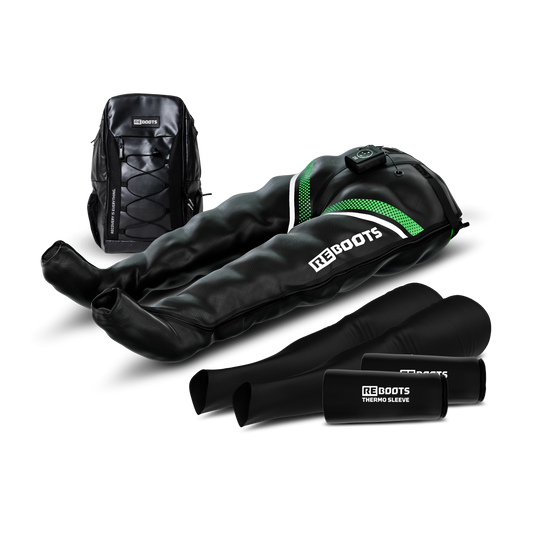


Many athletes choose a Bundle because it makes starting a Recovery routine easier.
A Bundle offers:
- a complete setup
- coordinated components
- easy integration into daily training
Especially during Ironman preparation, where Recovery is used regularly, this can be particularly practical.
How triathletes integrate Recovery Boots into their training routine
1. Recovery after intense sessions: Many athletes use Recovery Boots right after long or intense training sessions. Typical sessions last about 20–40 minutes.
2. Recovery on rest days: Recovery sessions can also be beneficial on rest days to consciously relax and wind down the body.
3. Routine before competitions: Some athletes use Recovery Boots during competition week as well—usually at moderate intensity to keep the legs fresh.

Conclusion:
Why Recovery Boots are beneficial for Ironman preparation
Ironman training places high demands on the body—especially the legs. In addition to training, nutrition, and sleep, recovery plays a central role.
Recovery Boots can be a practical tool for triathletes to consciously integrate recovery into their training routine.
Those who train regularly and have high volumes often benefit from planning recovery as structured as the training itself.
You might also be interested in this


Scientifically Proven
REBOOTS ACCELERATE RECOVERY
The study in collaboration with Innowearable shows that our compression massage regenerates the neuromuscular nervous system more effectively than passive recovery – for faster coordination, greater resilience, and improved training readiness.